Choosing the right health insurance policy is important, but understanding how to use it during hospitalisation is equally essential. When you or a family member needs medical treatment, you may have two ways to settle eligible hospital expenses: cashless health insurance or reimbursement health insurance claims.
Many policyholders assume that cashless insurance means every hospital bill is paid directly by the insurer. Others believe reimbursement guarantees that the insurer will refund the entire amount spent on treatment. In reality, both claim settlement methods are subject to policy terms, coverage limits, exclusions, and approval procedures.
Understanding Cashless vs Reimbursement Health Insurance can help you prepare for hospitalisation, manage medical expenses, and choose the right policy for your needs.
In this guide, we explain the meaning of cashless and reimbursement claims, their key differences, benefits, disadvantages, required documents, and how to choose the most suitable option in India.
What Is Cashless Health Insurance?
Cashless health insurance allows an insured person to receive eligible medical treatment at a hospital through a direct settlement arrangement between the insurer, its authorised claims administrator where applicable, and the hospital.
Instead of paying the entire eligible hospital bill upfront, the policyholder requests cashless authorisation. If the request is approved, the insurer settles the approved amount directly with the hospital, subject to the policy’s terms and limits.
For example, suppose you have health insurance with a sum insured of ₹5 lakh and undergo an eligible treatment at a hospital where cashless services are available under your policy. If the insurer approves ₹80,000 of eligible expenses, that approved amount can be settled directly with the hospital.
You may still need to pay expenses that are not covered, applicable deductibles or co-payments, and any other amount not approved under the policy.
How Does Cashless Health Insurance Work?
The typical cashless claim process involves these steps:
- Choose an eligible hospital: Check whether the hospital offers cashless treatment under your policy or the applicable insurer arrangement.
- Provide your insurance details: Submit your health insurance card or policy information and identification documents.
- Request pre-authorisation: The hospital submits the required treatment and medical details to the insurer or claims administrator.
- Wait for the decision: The insurer reviews the request according to the policy conditions.
- Receive treatment: Once the necessary authorisation is granted, treatment proceeds according to medical requirements and hospital procedures.
- Final claim settlement: The insurer settles the approved amount directly with the hospital. You pay any applicable non-payable or uncovered expenses.
For emergency admissions, follow the hospital’s and insurer’s emergency notification procedures as soon as possible.
Important: Cashless authorisation is not a guarantee that the entire final bill will be covered. The final settlement depends on the policy terms, treatment details, available sum insured, and claim assessment.
What Is Reimbursement Health Insurance?
Reimbursement health insurance refers to a claim process in which the policyholder initially pays eligible medical expenses and later submits a claim to the insurer for assessment and reimbursement.
This option may be useful when treatment takes place at a hospital where cashless settlement is unavailable or when cashless authorisation cannot be obtained but the policy otherwise permits a reimbursement claim.
For example, imagine your hospital bill is ₹60,000. You pay the hospital and submit the required claim form, bills, prescriptions, discharge summary, and other supporting documents. If the insurer determines that ₹50,000 is admissible under your policy, it may reimburse ₹50,000 after applying relevant deductions.
The remaining amount may be your responsibility because of exclusions, limits, co-payments, deductibles, or other policy conditions.
How Does Reimbursement Health Insurance Work?
The reimbursement process usually follows these steps:
- Receive medical treatment: Visit a hospital and pay the applicable medical expenses.
- Collect the documents: Keep original bills where required, payment receipts, prescriptions, investigation reports, and discharge documents.
- Notify the insurer: Follow the policy’s requirements for informing the insurer about hospitalisation and filing the claim.
- Submit the claim: Complete the claim form and provide the requested supporting documents.
- Claim assessment: The insurer reviews the documents, coverage, and admissible expenses.
- Receive the settlement: If the claim is approved, the admissible amount is paid according to the insurer’s settlement process.
Reimbursement claims may take time to process, especially if documents are missing or additional clarification is needed.
Cashless vs Reimbursement Health Insurance: Key Differences
Both methods can provide access to benefits under the same health insurance policy, but the payment process differs.
| Feature | Cashless Health Insurance | Reimbursement Health Insurance |
|---|---|---|
| Initial payment | Usually no need to pay the entire approved bill upfront | You generally pay the hospital first |
| Settlement | Approved amount is settled directly with the hospital | Admissible amount is paid to the policyholder after assessment |
| Hospital choice | Subject to cashless availability and policy conditions | May be available for eligible treatment at other hospitals, subject to policy terms |
| Documentation | Hospital usually coordinates authorisation and billing documents | Policyholder usually submits the claim documents |
| Immediate financial burden | Often lower for approved expenses | May be higher because you initially pay the bill |
| Claim approval | Pre-authorisation and final assessment may apply | Claim assessment occurs after submission |
| Out-of-pocket expenses | Uncovered charges and applicable cost-sharing may remain payable | Expenses not admitted under the policy remain your responsibility |
| Best suited for | People seeking direct settlement and less upfront payment | Situations where cashless settlement is unavailable or reimbursement is otherwise appropriate |
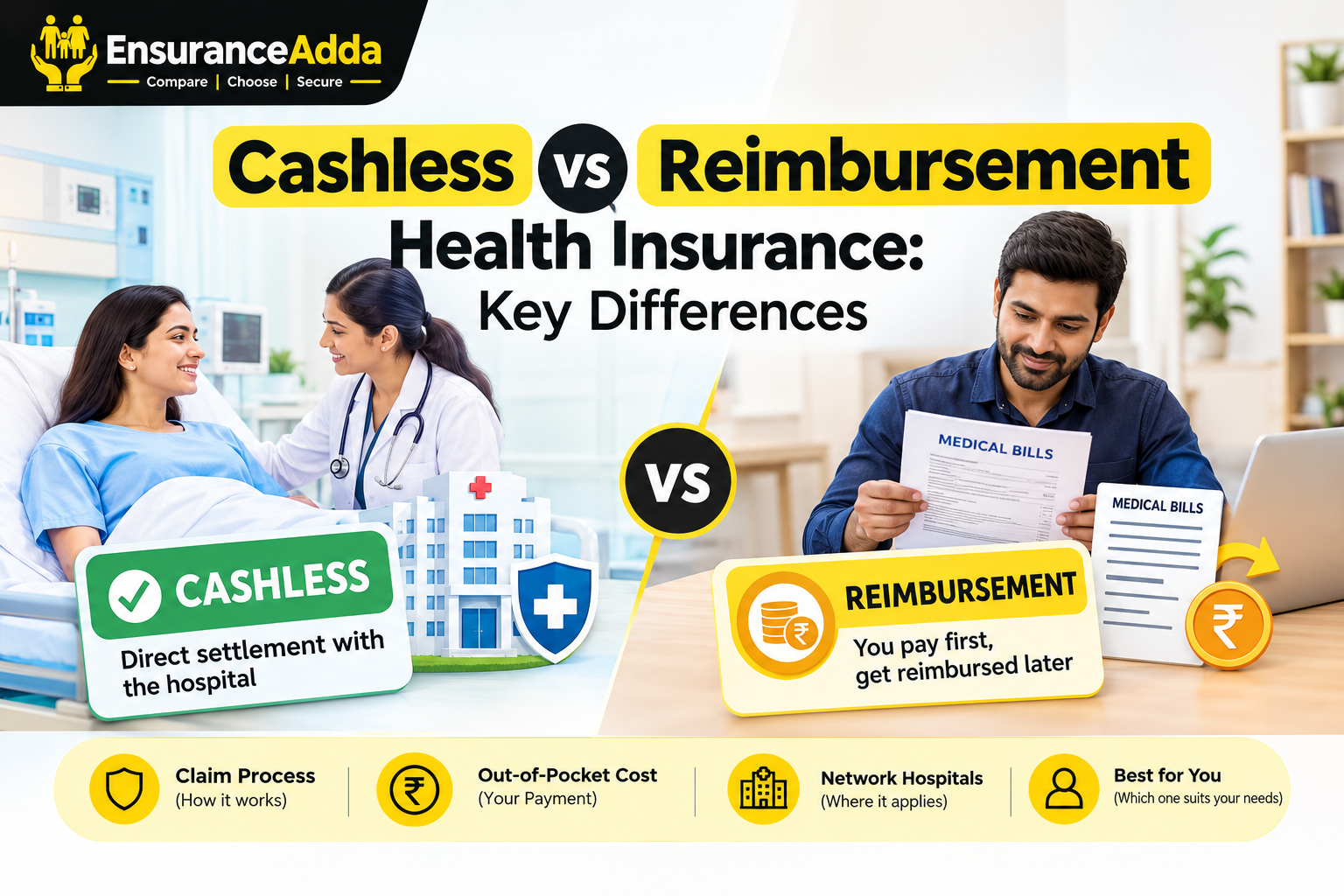
The most important distinction is who pays the hospital first. In cashless claims, the insurer settles the approved amount directly with the hospital. In reimbursement claims, you pay first and claim the admissible amount later.
Advantages of Cashless Health Insurance
Cashless health insurance offers several practical benefits during hospitalisation.
1. Lower Upfront Financial Pressure
Hospital treatment can be expensive. Cashless settlement can reduce the amount you need to arrange immediately because the insurer pays the approved portion directly to the hospital.
2. Convenient Claim Coordination
The hospital’s insurance desk generally assists with the authorisation process and submits the necessary treatment details to the insurer or claims administrator.
3. Less Need to Arrange Large Payments
When a claim is approved, you may not need to arrange the entire eligible hospital bill from personal savings.
4. Useful During Emergencies
During an unexpected hospital admission, cashless treatment can be particularly helpful when arranging a large upfront payment would be difficult. However, authorisation and notification requirements still apply.
5. Easier Expense Planning
Knowing the approved amount and the expected patient contribution can help you prepare for uncovered expenses, subject to final settlement.
Advantages of Reimbursement Health Insurance
Reimbursement claims also have important uses.
1. An Alternative When Cashless Is Unavailable
If a hospital does not offer cashless settlement under your policy, reimbursement may be an option if the hospital and treatment are otherwise eligible under your policy.
2. Potentially More Flexibility in Hospital Selection
Depending on the policy, you may be able to claim eligible expenses from a hospital outside the cashless network. Always check the policy’s hospital eligibility requirements and exclusions.
3. Useful for Certain Planned Treatments
If you arrange treatment at a facility where cashless settlement is not available, reimbursement may allow you to claim admissible expenses afterwards.
4. Available Under Many Health Insurance Policies
Cashless and reimbursement are often alternative claim settlement methods under the same policy rather than separate insurance products. The applicable terms determine which method is available.
Disadvantages of Cashless vs Reimbursement Claims
Each method has limitations that policyholders should understand.
Cashless Claim Limitations
- Cashless treatment depends on availability and applicable hospital arrangements.
- Pre-authorisation may be required and can be delayed while additional information is reviewed.
- The insurer may approve only part of the estimated bill.
- Non-payable items and applicable co-payments may remain the patient’s responsibility.
Reimbursement Claim Limitations
- You may need sufficient savings or funds to pay the hospital bill upfront.
- Claim submission requires careful document management.
- Missing documents can delay assessment.
- The insurer may approve less than the amount claimed if some expenses are not covered.
Neither method guarantees full payment of every hospital expense. Understanding the policy is essential before selecting treatment arrangements.
Documents Required for Cashless Health Insurance Claims
The hospital and insurer may request different documents depending on the treatment and claim circumstances. Common requirements include:
- Health insurance card or policy details.
- Identity proof of the insured person.
- Doctor’s consultation notes and treatment recommendations.
- Hospital admission and pre-authorisation forms.
- Medical investigation reports.
- Discharge summary and final hospital bill, when applicable.
The hospital’s insurance desk generally helps coordinate the cashless authorisation process.
Documents Required for Reimbursement Health Insurance Claims
For reimbursement, you may need to submit:
- Completed claim form.
- Health insurance policy details.
- Original hospital bills and payment receipts, where required.
- Discharge summary.
- Prescriptions and medical investigation reports.
- Pharmacy bills and supporting prescriptions.
- Doctor’s consultation records.
- Bank account details for claim payment.
- Other documents requested by the insurer.
Keep copies of submitted documents and follow the insurer’s claim submission deadlines. Requirements vary by insurer and policy.
Is Cashless Health Insurance Better Than Reimbursement?
For many policyholders, cashless health insurance is more convenient because it reduces the need to pay the entire approved hospital bill upfront.
However, reimbursement can be valuable when cashless settlement is unavailable and the policy permits a claim for treatment at the chosen hospital.
Consider these factors before deciding:
- Your financial situation: Would paying a large hospital bill upfront be difficult?
- Hospital availability: Are suitable hospitals near you eligible for cashless treatment?
- Policy conditions: Does your policy permit reimbursement for the hospital you intend to use?
- Claim procedures: Do you understand the notification, authorisation, and document requirements?
- Out-of-pocket expenses: Are you prepared to pay applicable deductibles, co-payments, and uncovered charges?
You should compare the full coverage of the policy rather than choosing a health insurance plan based only on its claim settlement method.
Tips to Avoid Health Insurance Claim Problems
Whether you use cashless or reimbursement settlement, these practices can help reduce avoidable difficulties.
- Read the policy wording and customer information sheet before purchasing insurance.
- Check waiting periods, exclusions, co-payments, deductibles, and sub-limits.
- Confirm cashless availability with the insurer and hospital before planned treatment.
- Inform the insurer within the applicable timeframe.
- Keep medical bills, prescriptions, and reports organised.
- Provide accurate information when purchasing the policy and submitting claims.
- Ask the insurer to explain any deduction or rejection in writing.
- Keep copies of claim forms, submitted documents, and communications.
For planned hospitalisation, verify the applicable authorisation requirements in advance. For emergency treatment, prioritise medical care and notify the insurer as soon as reasonably possible.
Frequently Asked Questions
1. What is the main difference between cashless and reimbursement health insurance?
In a cashless claim, the insurer settles the approved amount directly with the hospital. In a reimbursement claim, you generally pay the hospital first and receive the admissible amount from the insurer after claim assessment.
2. Can I use reimbursement if cashless treatment is unavailable?
Often, yes, provided your policy allows reimbursement for the hospital and treatment concerned and all applicable conditions are met. Check with your insurer before assuming the claim will be accepted.
3. Does cashless health insurance mean zero expenses?
No. You may still have to pay non-covered expenses, deductibles, co-payments, room-related deductions, or amounts exceeding applicable limits.
4. How long does reimbursement take?
The time required depends on the insurer, the applicable claim-processing requirements, and whether all necessary documents have been received. Ask your insurer for the current processing timelines and applicable regulatory requirements.
5. Can I choose any hospital for reimbursement?
Hospital eligibility depends on the policy. Some policies allow eligible reimbursement claims at hospitals outside the cashless network, while other restrictions may apply. Review your policy before treatment whenever possible.
6. Do I need separate policies for cashless and reimbursement claims?
Usually, no. Many health insurance policies provide both settlement methods, subject to the policy terms and the circumstances of treatment.
7. What should I do if my cashless claim is rejected?
Ask the insurer for the reason in writing, review the relevant policy terms, and check whether reimbursement is permitted in your circumstances. You can submit additional information or use the insurer’s grievance procedure if appropriate.
Conclusion
Understanding cashless vs reimbursement health insurance can help you prepare for medical emergencies and make better decisions about hospital expenses.
Cashless claims can reduce the need for upfront payments by settling approved expenses directly with the hospital. Reimbursement claims offer an alternative when you pay eligible expenses first and seek payment from the insurer afterwards.
Both methods remain subject to policy terms, exclusions, claim documentation, and approval. Before purchasing health insurance, compare the coverage, hospital access, cost-sharing provisions, and claim procedures so you can select a policy that fits your healthcare needs and financial situation.