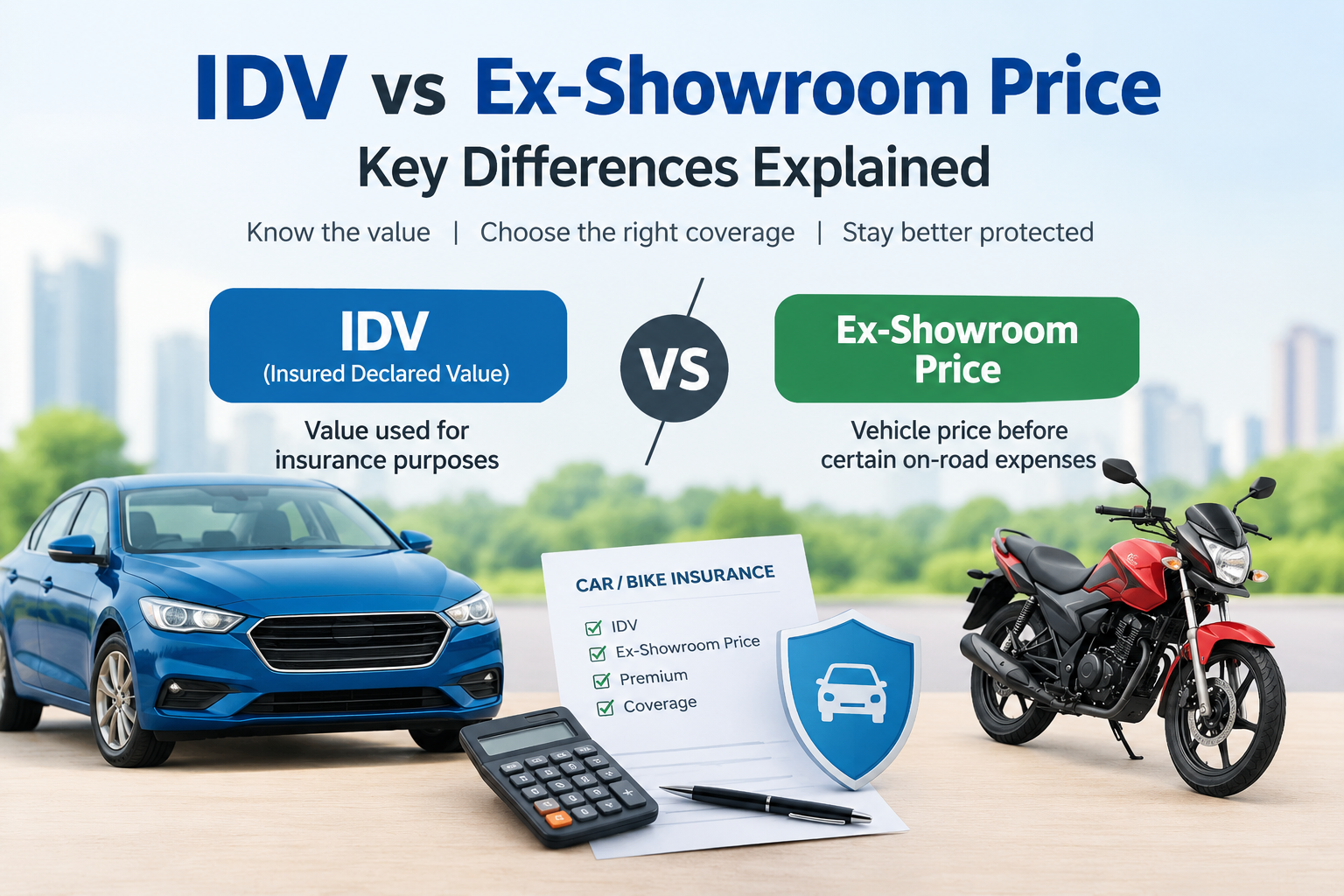
Buying or renewing bike insurance can feel confusing when you need to decide how much your motorcycle or scooter is worth. One important factor to understand is the Insured Declared Value (IDV). It helps determine the insured value of your vehicle and can affect your own-damage insurance premium and the amount considered during certain claims.
A Bike IDV Calculator helps you estimate your two-wheeler’s insured value based on factors such as its age, original listed price and applicable depreciation. Knowing your bike’s approximate IDV can help you compare insurance policies, understand premium differences and make a more informed renewal decision.
Whether you own a new motorcycle, an older scooter or a daily-use commuter bike, understanding IDV can help you choose insurance more confidently. In this guide, you will learn how bike IDV works, how it is calculated, what affects it and how to use an IDV estimate when purchasing insurance.
What Is IDV in Bike Insurance?
IDV stands for Insured Declared Value. In motor insurance, it generally represents the insured value assigned to your vehicle, taking depreciation into account under the applicable rules.
For a bike or scooter, IDV is particularly relevant when calculating the own-damage premium and assessing certain claims involving theft or total loss, subject to the policy terms and applicable conditions.
For example, a new bike may have a higher IDV than the same model that has been used for several years. This happens because the vehicle’s value generally decreases with age and use.
However, IDV is not necessarily the price you would receive if you sold your bike in the second-hand market. The resale price can also depend on mileage, mechanical condition, service history, location and demand for that model.
How Does a Bike IDV Calculator Work?
A Bike IDV Calculator estimates the insured value of your two-wheeler using relevant vehicle details and an applicable valuation method.
Depending on the calculator, you may need to provide:
- Bike manufacturer and model
- Variant or version
- Original ex-showroom price or applicable vehicle value
- Registration date or vehicle age
- Vehicle condition and other details, where requested
The calculator then applies the relevant depreciation or valuation method to estimate IDV.
The result is an estimate, not a guarantee of the IDV offered by every insurer. The final insured value should be confirmed against the insurer’s quote and policy terms.
How to Calculate Bike IDV: Formula and Example
A simplified way to understand IDV is to subtract the applicable depreciation from the relevant vehicle value.
Simplified formula:
Bike IDV = Relevant vehicle value − Applicable depreciation
For example, suppose the relevant original vehicle value is ₹1,00,000 and the applicable depreciation is 30%.
Depreciation amount = ₹1,00,000 × 30% = ₹30,000
Estimated IDV = ₹1,00,000 − ₹30,000 = ₹70,000
In this simplified example, the estimated IDV is ₹70,000.
The actual calculation depends on the vehicle’s age, the applicable motor insurance rules and the insurer’s valuation method. For standard private vehicles, the depreciation schedule prescribed under the applicable motor insurance framework may be used. The simplified example above should not be treated as a universal depreciation table.
Why Is Depreciation Important?
Depreciation reflects the reduction in a vehicle’s value over time. As a bike gets older, its IDV will generally decrease.
For standard motor insurance IDV calculations, the applicable depreciation schedule may include age-based percentages such as:
- Up to 6 months: 5%
- More than 6 months and up to 1 year: 15%
- More than 1 year and up to 2 years: 20%
- More than 2 years and up to 3 years: 30%
- More than 3 years and up to 4 years: 40%
- More than 4 years and up to 5 years: 50%
These are commonly referenced standard depreciation brackets for vehicle valuation. Confirm the current applicable rules and insurer’s calculation, particularly for vehicles older than five years or cases requiring a different valuation method.
Factors That Affect Your Bike’s IDV
Your bike’s IDV is not based on age alone. Several factors can influence its estimated insured value.
1. Age of the Bike
Age is one of the main factors affecting IDV. A newly purchased bike generally has a higher IDV than an older bike of the same model, all else being equal.
2. Original Vehicle Price
The relevant original price of the vehicle is an important starting point in standard IDV calculations. Make sure you use the appropriate price rather than automatically using the current resale value.
3. Make and Model
Different motorcycles and scooters have different original values. A premium motorcycle and an entry-level scooter will not have the same IDV, even if they are of a similar age.
4. Accessories and Modifications
Certain electrical and non-electrical accessories may be treated differently from the vehicle’s standard equipment. Their valuation and insurance treatment depend on the applicable policy and insurer’s rules.
5. Vehicle Age and Valuation Method
Older vehicles may require a different valuation approach. If your bike is more than five years old, check how your insurer determines its IDV rather than assuming that a simple age-based formula will always provide the correct result.
Why Should You Use a Two Wheeler IDV Calculator?
Using a Two Wheeler IDV Calculator before purchasing or renewing insurance can help you understand your policy options.
Helps You Compare Insurance Quotes
Different IDV selections can produce different premium quotations. An estimate helps you understand whether the insured values shown by different insurers are broadly comparable.
Helps You Understand Your Bike’s Insured Value
You can get a clearer idea of the value assigned to your vehicle for insurance purposes rather than relying only on its purchase price.
Supports Better Renewal Decisions
Before renewing your bike insurance, reviewing the proposed IDV can help you identify significant differences between quotations and ask your insurer for clarification.
Helps You Understand Total-Loss and Theft Cover
IDV is important when a covered theft or total-loss claim is assessed, subject to the policy wording, exclusions, deductibles and applicable settlement conditions.
Remember that IDV does not automatically guarantee a payout equal to the displayed figure in every claim. The insurer must assess the claim according to the policy terms.
How to Choose the Right IDV for Your Bike
Choosing an appropriate IDV involves balancing the insured value with the premium and the protection you want.
Follow these practical steps:
- Enter accurate bike details: Select the correct manufacturer, model, variant and registration date.
- Check the estimated IDV: Use a Bike IDV Calculator to understand the approximate insured value.
- Compare insurer quotations: Check the IDV, own-damage premium, deductibles and coverage offered.
- Avoid choosing only by price: A lower premium may come with differences in coverage, deductibles or other policy conditions.
- Review the final policy: Confirm the selected IDV before making payment and check the policy document after issuance.
Do not assume that choosing a higher IDV is always the best option. An appropriate value should follow the applicable valuation method and the insurer’s permitted limits.
Does a Higher Bike IDV Increase the Insurance Premium?
In general, a higher IDV can increase the own-damage portion of a bike insurance premium because the insurer may be exposed to a higher insured value in certain claims.
A lower IDV may reduce the premium in some cases, but it can also reduce the amount considered for a covered total-loss or theft claim.
The overall premium also depends on other factors, including the vehicle, location, policy type, selected add-ons, deductibles and applicable taxes.
Third-party liability premiums are determined separately under the relevant rules. Therefore, a change in IDV does not necessarily change every component of your insurance premium in the same way.
The practical approach is to compare the final quotations and choose a suitable IDV rather than selecting the lowest or highest figure without checking the details.
Bike IDV vs Bike Resale Value: What Is the Difference?
Bike IDV and resale value are related to a vehicle’s value, but they serve different purposes.
Bike IDV is the value assigned for motor insurance purposes under the applicable valuation method and policy terms.
Bike resale value is the amount a buyer may be willing to pay for your used motorcycle or scooter.
For example, a bike may have an insurance IDV of ₹50,000 while a potential buyer offers ₹55,000 or ₹45,000. The actual resale amount depends on market demand, mileage, maintenance, condition and negotiation.
Therefore, do not use an online resale estimate as a direct substitute for your insurer’s IDV.
Common Mistakes to Avoid When Calculating Bike IDV
Avoid these mistakes when estimating your bike’s insured value:
- Entering the wrong model or variant into the calculator.
- Using an incorrect purchase price or registration date.
- Assuming that the resale price and IDV are identical.
- Selecting an IDV without checking the insurer’s permitted valuation range.
- Choosing a policy based only on the lowest premium.
- Ignoring deductibles, exclusions and add-on conditions.
- Assuming that the calculator result guarantees a particular claim settlement.
Checking these details before purchasing or renewing insurance can help reduce confusion and make policy comparisons more meaningful.
When Should You Check Your Bike’s IDV?
It is useful to check your bike’s IDV in several situations:
- When purchasing a new bike insurance policy.
- When renewing an existing policy.
- When comparing comprehensive insurance quotations.
- When checking the valuation of an older motorcycle or scooter.
- When reviewing the insured value offered by an insurer.
You can also review the IDV stated in your existing policy to understand how the insured value has changed as your vehicle has aged.
Frequently Asked Questions About Bike IDV Calculator
1. What is a Bike IDV Calculator?
A Bike IDV Calculator is a tool that estimates the insured value of a motorcycle or scooter using vehicle details, age and the applicable valuation method.
2. How do I calculate my bike’s IDV?
A simplified calculation subtracts the applicable depreciation from the relevant vehicle value. The actual calculation depends on the vehicle’s details, applicable rules and insurer’s valuation method.
3. Does bike IDV decrease every year?
IDV generally decreases as a vehicle ages because depreciation is considered. The exact change depends on the applicable valuation method and the insurer’s assessment.
4. Is bike IDV the same as resale value?
No. IDV is used for insurance valuation, while resale value is the amount a buyer may pay for a used bike in the market.
5. Does a higher IDV mean a higher premium?
A higher IDV can increase the own-damage premium, although the final premium also depends on coverage, deductibles, add-ons and other rating factors.
6. Can I choose any IDV for my bike?
No. The IDV generally needs to fall within the insurer’s permitted range and follow the applicable valuation rules. Confirm the available options with your insurer.
7. Where can I check my bike’s IDV?
You can check the IDV in your insurance quotation or policy document. You can also use an online Bike IDV Calculator for an estimate before comparing policies.
Conclusion
A Bike IDV Calculator is a useful starting point for understanding your motorcycle or scooter’s insured value. By checking the vehicle’s age, relevant original price and applicable depreciation, you can estimate IDV and make more informed insurance comparisons.
Before buying or renewing your policy, compare the IDV alongside the premium, coverage, deductibles and exclusions. Do not choose an insured value based only on a low premium or an assumed resale price.
Understanding IDV can help you make a more confident decision about two-wheeler insurance and the protection available under your policy.