
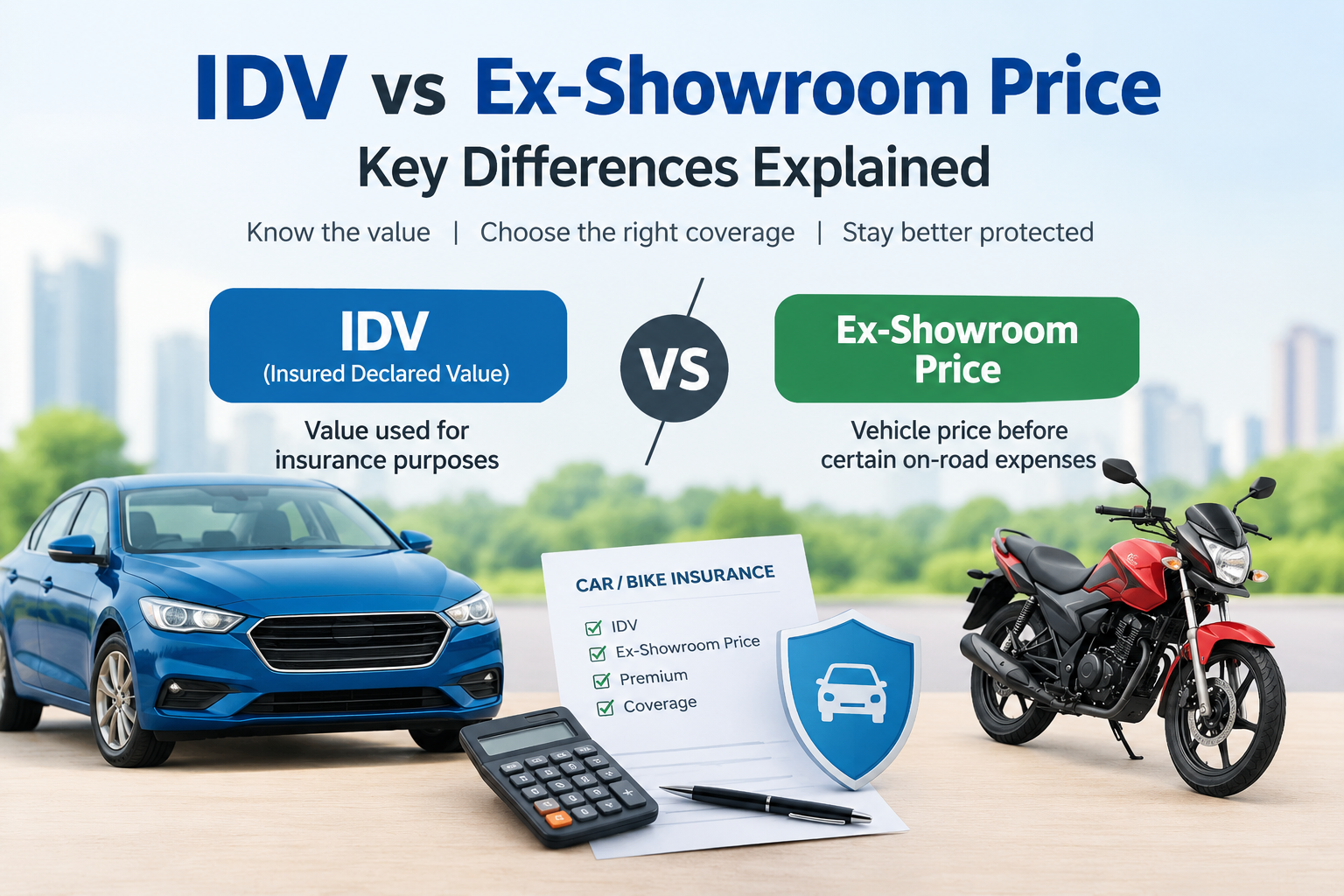
When buying car or bike insurance in India, two terms that often create confusion are Insured Declared Value (IDV) and ex-showroom price. Both relate to your vehicle’s value, but they serve different purposes. Understanding the difference can help you choose suitable insurance coverage and avoid unrealistic expectations during a claim.
The IDV vs Ex-Showroom Price comparison is especially important when renewing a policy or insuring a new vehicle. While the ex-showroom price reflects the vehicle’s original selling price before certain on-road expenses, IDV represents the insured value used in motor insurance, subject to the policy terms.
In this guide, you will learn what IDV and ex-showroom price mean, how they differ, how depreciation affects IDV, and which value matters when buying car or bike insurance.
What Is IDV in Car and Bike Insurance?
Insured Declared Value (IDV) is the value assigned to a vehicle for insurance purposes. It generally represents the vehicle’s insured value after applying the relevant depreciation or valuation method under the policy.
IDV is particularly important for own-damage cover. In the event of a total loss or constructive total loss, the settlement is generally assessed with reference to the applicable IDV and policy conditions. It does not mean that every claim will automatically be paid at the full IDV.
For a new vehicle, the insurer determines the applicable value according to the policy and relevant motor insurance rules. For an older vehicle, depreciation and the insurer’s valuation method can reduce its IDV.
Why is IDV important?
- It helps determine the insured value of your vehicle.
- It can affect the own-damage premium.
- It is relevant to total-loss and constructive-total-loss claim settlements.
- It helps you compare insurance quotations for similar coverage.
You can use an IDV Calculator to estimate a vehicle’s value for insurance purposes. Treat the result as an estimate and check the final IDV shown in the insurer’s quotation.
What Is Ex-Showroom Price?
The ex-showroom price is the price announced by a vehicle dealer or manufacturer for a vehicle at the showroom, before certain additional on-road expenses.
Depending on the vehicle and the quotation, it generally excludes costs such as:
- Vehicle registration charges
- Road tax
- Number plate or registration-related fees
- Optional accessories and other additional charges
The exact inclusions can vary, so check the dealer’s price breakdown rather than assuming every quotation includes the same items.
For example, a new bike may have an ex-showroom price of ₹1,00,000, while its on-road price is higher after applicable road tax, registration and other charges are added.
The ex-showroom price is useful when comparing new vehicles from different brands or dealerships. However, it is not automatically the same as the IDV shown on an insurance policy.
IDV vs Ex-Showroom Price: Key Differences
The main difference is that ex-showroom price relates to the vehicle’s original showroom pricing, while IDV is an insurance valuation.
| Comparison point | IDV | Ex-showroom price |
|---|---|---|
| Meaning | Insured value used for motor insurance | Vehicle price quoted before certain on-road expenses |
| Main purpose | Insurance valuation and relevant claim calculations | Vehicle purchase-price comparison |
| Depends on | Vehicle details, age, depreciation and applicable valuation rules | Manufacturer or dealer pricing and vehicle variant |
| Changes over time | Usually changes as the vehicle ages and is revalued | Original purchase price remains a historical reference, though listed prices can change |
| Used for | Insurance premium calculations and relevant total-loss settlements | Comparing the prices of new vehicles |
| Includes on-road expenses? | Not simply the total on-road purchase cost | Generally excludes registration and road tax |
| Applies to older vehicles? | Yes, with valuation based on applicable methods | The original ex-showroom price may be used as a historical reference |
In short, IDV is an insurance-related value, while ex-showroom price is a vehicle-pricing figure.
Example: How IDV and Ex-Showroom Price Differ
Suppose you purchase a new bike with an ex-showroom price of ₹1,00,000. After registration, road tax and other applicable expenses, its on-road price becomes ₹1,15,000.
The insurer may display an IDV in the policy quotation based on the applicable valuation method. That figure should not automatically be assumed to equal either ₹1,00,000 or ₹1,15,000.
As the bike gets older, depreciation and the applicable valuation method may reduce its IDV. Its original ex-showroom price, however, remains the historical price at which the vehicle was listed or purchased.
This example shows why you should check the actual IDV stated in your policy rather than using the on-road price or the original showroom price as a substitute.
How Is IDV Calculated?
For many standard motor insurance policies, IDV is determined using the vehicle’s listed selling price and the applicable depreciation schedule or valuation method. The precise method can depend on the vehicle, its age, the policy wording and relevant insurance rules.
A simplified way to understand the calculation is:
Estimated IDV = Applicable vehicle value − Applicable depreciation
This is a conceptual explanation, not a universal formula for every vehicle or policy. Additional considerations may apply to accessories, vehicles beyond standard age brackets, and certain policy types.
When buying insurance, compare the IDV offered by insurers for the same vehicle details and coverage. A quotation with a higher IDV may have a higher premium, while a lower IDV can reduce the premium but may also affect the amount considered in a covered total-loss claim.
Does IDV Affect Your Car or Bike Insurance Premium?
Yes, IDV can affect the own-damage component of a motor insurance premium. The relationship is not the only factor that determines the price.
Other factors can include:
- Vehicle make, model and variant
- Vehicle age and registration location
- Type of insurance policy
- Selected add-ons
- Voluntary deductible
- Applicable discounts and insurer pricing
Third-party liability premiums are determined under a different framework from the own-damage portion. Therefore, changing the IDV does not necessarily change every component of the total premium in the same way.
When comparing quotes, check the IDV alongside the coverage, exclusions, deductibles and add-ons. Do not choose an unrealistically low value simply to reduce the premium.
Which Value Matters When Buying Insurance?
Both values can be useful, but they answer different questions.
Ex-showroom price helps you understand the original showroom cost of a new vehicle. It is useful when comparing models and understanding the purchase-price breakdown.
IDV helps you understand the vehicle value recorded for insurance purposes. It is particularly relevant when comparing own-damage policies and understanding total-loss claim conditions.
If you are insuring a new car or bike, provide accurate vehicle details and review the IDV offered by the insurer. If you are renewing an older vehicle’s policy, check whether the proposed IDV is reasonable for the vehicle’s age and condition.
Common Mistakes to Avoid
1. Assuming IDV equals the on-road price
The on-road price can include road tax, registration and other expenses that do not automatically become part of the insured vehicle value.
2. Treating the original ex-showroom price as the current IDV
A vehicle’s insurance valuation can change as it ages. Always review the current policy quotation.
3. Choosing the lowest IDV only to save money
A lower IDV may reduce some premium components, but it can also affect the amount considered in a covered total-loss settlement.
4. Ignoring policy terms
Claim settlements depend on the policy wording, applicable conditions, deductibles and exclusions. Read the terms before purchasing or renewing.
5. Comparing premiums without comparing coverage
Two policies may have different IDVs, add-ons, deductibles or exclusions. Compare like-for-like coverage before making a decision.
Frequently Asked Questions
1. Is IDV the same as ex-showroom price?
No. Ex-showroom price is the vehicle’s showroom price before certain on-road expenses. IDV is the value assigned for insurance purposes under the applicable valuation method and policy terms.
2. Is IDV higher than the ex-showroom price?
Not necessarily. The figures depend on the vehicle, its age, valuation method and policy details. Do not assume one will always be higher than the other.
3. Does ex-showroom price include road tax and registration?
Generally, no. Road tax and registration charges are usually additional on-road expenses. Check the dealer’s quotation for the exact breakdown.
4. Why does IDV decrease as a vehicle gets older?
Depreciation and the applicable insurance valuation method generally reduce the insured value as a vehicle ages. The exact calculation depends on the relevant rules and policy terms.
5. Does a higher IDV mean a higher insurance premium?
It can increase the own-damage premium, although the final premium also depends on coverage, add-ons, deductibles, discounts and insurer pricing.
6. Which value should I check when renewing my bike insurance?
Check the IDV offered in the renewal quotation, along with the policy coverage, add-ons, exclusions and deductible. The original ex-showroom price alone is not enough to determine an appropriate current IDV.
Conclusion
Understanding the IDV vs Ex-Showroom Price difference helps you make more informed decisions when buying or renewing car and bike insurance. Ex-showroom price tells you about the vehicle’s original showroom pricing, while IDV represents its value for insurance purposes under the applicable valuation method.
Before purchasing a policy, review the IDV, compare similar coverage options, and read the policy conditions carefully. The right insurance decision should balance a reasonable insured value with suitable coverage and an affordable premium.