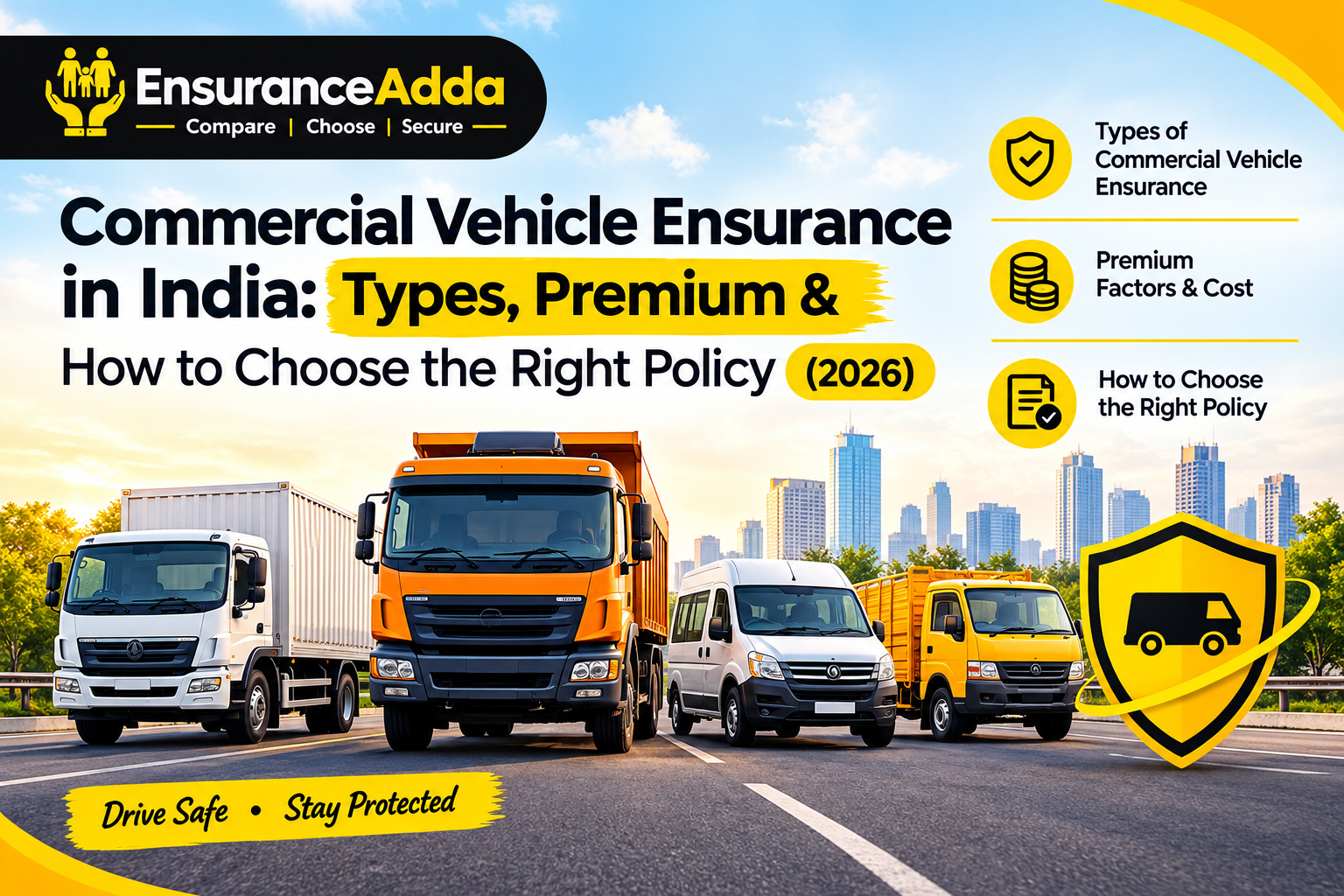
Commercial vehicle insurance in India is a legal requirement for every truck, taxi, bus, tempo and delivery van used for business. A single accident can bring a lawsuit, a damaged vehicle and weeks of lost income. The right policy protects your vehicle, your driver and your business.
This guide covers what the insurance is, the types of policies, how the premium is calculated, which add-ons are worth buying, and how to file a claim.
What Is Commercial Vehicle Insurance?
Commercial vehicle insurance is a motor policy for vehicles used for business: carrying goods, passengers or special equipment. Private car or bike insurance will not cover these vehicles, and an insurer can reject a claim if a commercial vehicle runs on a private policy.
Under the Motor Vehicles Act, third-party liability cover is mandatory for every vehicle on Indian roads. It is mandatory for every vehicle owner to have a third-party motor insurance policy.
Which Vehicles Need It?
Goods carrying vehicles
- Trucks and lorries
- Mini trucks and tempos
- Tippers and dumpers
- Goods three-wheelers and delivery vans
- Trailers and tankers
Passenger carrying vehicles
- Taxis and cabs
- Buses and school buses
- Auto-rickshaws and e-rickshaws
Miscellaneous and special-purpose vehicles
- Cranes, JCBs and earth-moving equipment
- Ambulances
- Garbage vans and other special-type vehicles
Types of Commercial Vehicle Insurance Policies
1. Third-Party (Liability Only) Policy
This is the minimum legal cover. It pays for injury or death of a third party, and damage to their property, caused by your vehicle. It does not pay for damage to your own vehicle.
Best for: very old vehicles, or owners on a tight budget who only need to meet the legal requirement.
2. Comprehensive (Package) Policy
It combines third-party liability with own-damage cover for accidents, fire, theft, floods, riots and other listed risks. It is the most popular choice for fleets and owner-operators.
Best for: newer vehicles and anyone who cannot afford a large repair bill.
3. Standalone Own-Damage Policy
It covers only your vehicle’s damage and can be bought if you already hold a valid third-party policy.
4. Fleet Insurance
If you own several vehicles, one fleet policy can cut paperwork and often earns a discount. It suits transport companies, logistics firms and cab operators.
Third-Party vs Comprehensive
| Feature | Third-Party | Comprehensive |
|---|---|---|
| Legally required | Yes | Yes (it includes third-party cover) |
| Third-party injury or death | Covered | Covered |
| Third-party property damage | Covered | Covered |
| Own vehicle damage | Not covered | Covered |
| Theft and fire | Not covered | Covered |
| Natural calamities | Not covered | Covered |
| Add-ons | Limited | Available |
| Premium | Lower | Higher |
How Much Does Commercial Vehicle Insurance Cost?
The premium has two parts.
1. Third-party premium (fixed by regulation). The government sets base third-party rates by vehicle category and weight. In the FY 2023-24 draft rules, goods carrying vehicles (other than three-wheelers) up to 7,500 kg were proposed at Rs 16,049, with higher-weight vehicles ranging from Rs 27,186 to Rs 44,242. For goods carrying three-wheelers, the proposed rate was Rs 4,492.
Editor’s note: These are FY 2023-24 draft figures. Third-party rates are revised from time to time, so check the latest MoRTH/IRDAI notification before publishing and update this section.
2. Own-damage premium (varies by insurer). Comprehensive premiums vary by vehicle type, age and location. It is calculated roughly as:
Own-Damage Premium = IDV × Insurer’s Rate (adjusted for discounts and loadings), plus add-on premiums and 18% GST
Factors That Affect Your Premium
| Factor | How It Affects the Premium |
|---|---|
| Vehicle type and gross vehicle weight (GVW) | Heavier vehicles cost more |
| IDV (Insured Declared Value) | Higher IDV means higher premium |
| Vehicle age | Older vehicles have a lower IDV and more repair risk |
| Make, model and fuel type | Spare-part costs differ by model |
| Area of use (local, state or national permit) | Wider operating radius means higher risk |
| Registration city or zone | Accident-prone zones cost more |
| Type of goods carried | Hazardous cargo costs more |
| Claim history and No Claim Bonus (NCB) | A clean record earns discounts on the own-damage premium |
| Add-ons and deductible | More add-ons raise the cost; a higher deductible lowers it |
Add-Ons Worth Considering
- Zero depreciation: claims are paid without deducting depreciation on replaced parts.
- Roadside assistance and towing: useful on long highway routes.
- Engine protection: covers engine damage from water ingression or oil leakage.
- Consumables cover: pays for nuts, bolts, oil and similar items.
- Legal liability to paid driver or cleaner: covers claims if your employee is hurt or killed.
- Compulsory personal accident cover for the owner-driver: required for owner-drivers, so check the current mandatory sum insured with your insurer.
- NCB protection: keeps your discount after a small claim.
- Geographical extension: needed if you operate across borders, such as to Nepal or Bhutan.
Documents Required to Buy or Renew
- Registration Certificate (RC)
- Permit and fitness certificate
- Driver’s licence (valid for the vehicle class)
- Previous policy copy (for renewal)
- Pollution Under Control (PUC) certificate
- KYC documents (Aadhaar, PAN)
- Photographs of the vehicle, if the insurer asks for an inspection
How to File a Claim
- Inform the insurer immediately. Use the helpline, app or branch, and note the claim number.
- File an FIR in cases of theft, major accident, third-party injury or death.
- Do not move or repair the vehicle before the surveyor’s inspection, unless it is needed for safety.
- Submit documents: claim form, RC, licence, policy copy, FIR and repair estimate.
- Survey and assessment: the insurer’s surveyor checks the damage.
- Repair and settlement: at a cashless garage the insurer pays directly, otherwise you pay and get reimbursed.
8 Tips to Reduce Your Premium
- Compare quotes from at least 3 to 4 insurers.
- Keep your claim record clean to build NCB.
- Choose a sensible voluntary deductible.
- Install GPS tracking and anti-theft devices.
- Buy a fleet policy if you own multiple vehicles.
- Pick add-ons that match your route and cargo.
- Renew before expiry, because a lapse can lose your NCB.
- Train drivers in safe driving, since fewer accidents mean lower renewals.
Common Mistakes to Avoid
- Buying only third-party cover for a new or high-value vehicle
- Declaring the wrong IDV, vehicle use or route
- Letting the policy lapse
- Using a driver without a valid licence for that vehicle class
- Carrying more load than the permitted GVW, which can lead to claim disputes
FAQs
1. Is commercial vehicle insurance mandatory in India?
Yes. At minimum, third-party liability insurance is compulsory for every vehicle used on public roads.
2. Can I use a private car policy for a taxi or delivery van?
No. A vehicle used for business needs a commercial policy, and a claim on a private policy can be rejected.
3. What does a third-party commercial vehicle policy not cover?
Damage to your own vehicle, theft, fire and natural calamities.
4. How is the IDV decided?
It is the manufacturer’s listed price minus depreciation based on the vehicle’s age. A higher IDV gives a larger claim payout but a higher premium.
5. Do I get a No Claim Bonus on commercial vehicles?
Yes, a discount on the own-damage premium is usually available if you made no claim in the previous policy year.
6. Can I buy fleet insurance for just two or three vehicles?
Many insurers offer fleet policies from a small number of vehicles, but the minimum differs by insurer. Check before buying.
7. How can I check if my commercial vehicle policy is active?
Use your insurer’s app or website with the policy number or vehicle registration number.
Conclusion
Commercial vehicle insurance protects both your vehicle and your livelihood. Third-party cover keeps you legal, but a comprehensive policy with the right add-ons protects you from a large repair bill. Compare quotes, declare details honestly, renew on time, and choose an insurer known for smooth claim settlement.