
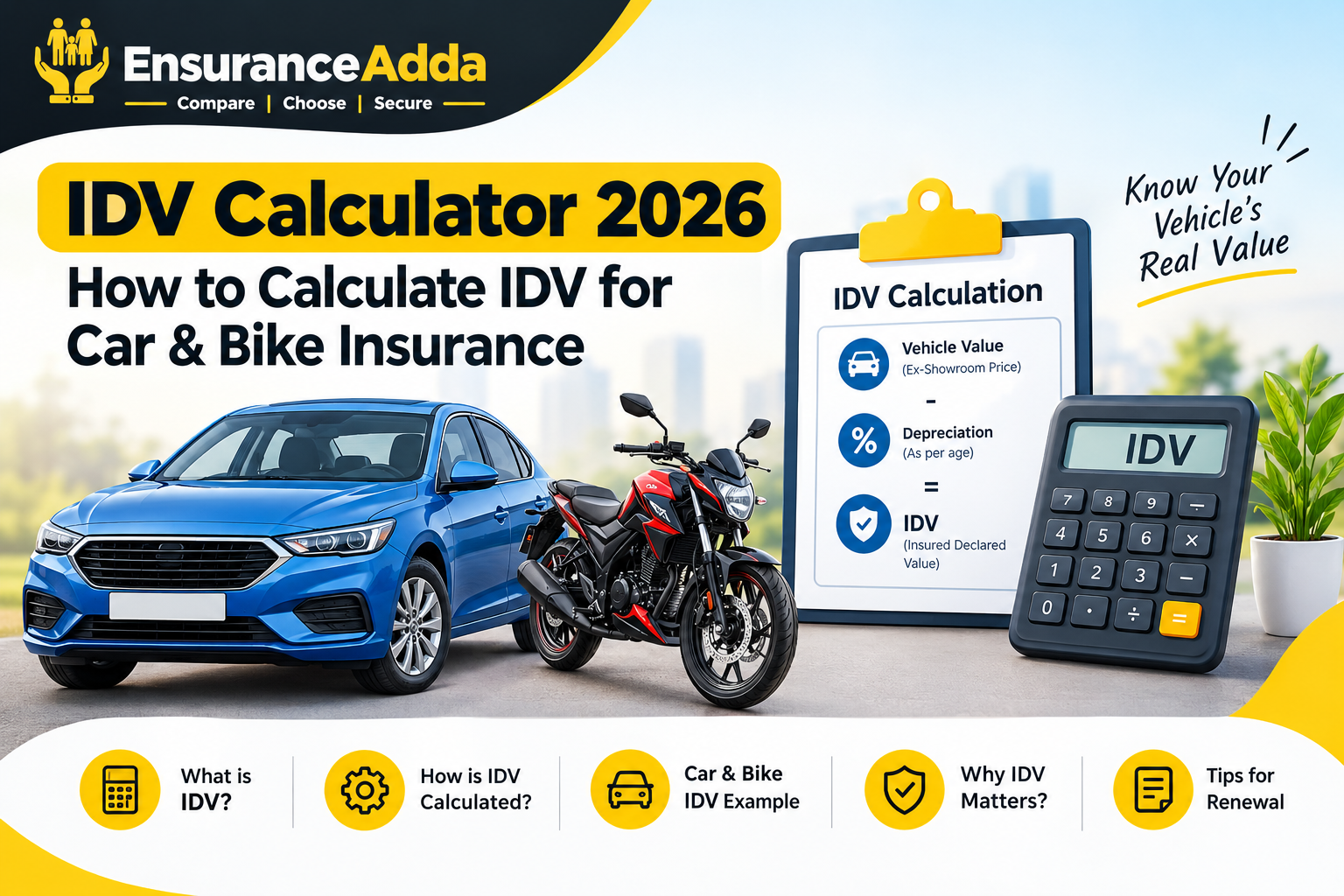
When you buy or renew car or bike insurance, you may come across an important term called IDV, or Insured Declared Value. It is one of the key factors that can affect your motor insurance coverage and premium.
If you are wondering what IDV means, how IDV is calculated, how much IDV your car or bike should have, or how depreciation affects IDV, this guide explains everything in simple language.
An IDV Calculator 2026 can help you estimate the current insured value of your vehicle based on its age, original listed price and applicable depreciation.
IDV stands for Insured Declared Value. It represents the approximate current value of your insured vehicle for the purpose of motor insurance.
What Is IDV in Motor Insurance?
In simple terms, IDV is the maximum amount generally considered for a total-loss or theft claim under the own-damage section of a motor insurance policy, subject to the policy terms and conditions.
For example, if your car has an IDV of ₹6 lakh and the vehicle is stolen and the claim is admissible, the IDV becomes an important reference point when determining the claim amount.
The IDV of a vehicle normally decreases as the vehicle gets older because of depreciation.
Why Is IDV Important in Car and Bike Insurance?
IDV is important because it can influence both your insurance premium and the amount available in a total-loss or theft situation.
A higher IDV can generally mean:
- Higher own-damage premium
- Higher insured value for the vehicle
- Potentially higher claim amount in a total-loss or theft situation, subject to policy terms
A lower IDV can generally mean:
- Lower premium
- Lower insured value
- Potentially lower claim amount in a total-loss or theft situation
Therefore, choosing an appropriate IDV is important when buying or renewing your car or bike insurance.
How Does an IDV Calculator Work?
An IDV Calculator estimates the value of your vehicle after applying the applicable depreciation.
The calculation generally considers factors such as:
- Manufacturer’s listed selling price
- Age of the vehicle
- Applicable depreciation
- Value of eligible accessories, where applicable
A simplified formula is:
IDV = Manufacturer’s Listed Price − Depreciation
The actual IDV offered by an insurer can depend on the policy, vehicle details and applicable insurance guidelines.
IDV Calculation Formula for Car and Bike
For a relatively new vehicle, the IDV is calculated by adjusting the manufacturer’s listed price for the applicable depreciation.
Basic IDV Formula
IDV = Original Listed Price − Depreciation
For example, suppose a bike has a manufacturer’s listed price of ₹1,00,000 and applicable depreciation is 20%.
Depreciation:
₹1,00,000 × 20% = ₹20,000
Estimated IDV:
₹1,00,000 − ₹20,000 = ₹80,000
This is a simplified example. The final IDV offered by an insurer may differ depending on the vehicle and policy.
IDV Depreciation Rates
Depreciation is one of the most important factors in calculating IDV.
A commonly used depreciation schedule for vehicles is:
| Vehicle Age | Depreciation |
|---|---|
| Up to 6 months | 5% |
| More than 6 months to 1 year | 15% |
| More than 1 year to 2 years | 20% |
| More than 2 years to 3 years | 30% |
| More than 3 years to 4 years | 40% |
| More than 4 years to 5 years | 50% |
For vehicles older than five years, the IDV is generally determined based on the vehicle’s condition and other factors agreed between the insurer and insured rather than simply applying the above fixed depreciation table.
Car IDV Calculation Example
Let’s understand the calculation with an example.
Suppose:
- Original listed price: ₹10,00,000
- Vehicle age: 2.5 years
- Applicable depreciation: 30%
Depreciation:
₹10,00,000 × 30% = ₹3,00,000
Estimated IDV:
₹10,00,000 − ₹3,00,000 = ₹7,00,000
Therefore, the estimated IDV would be ₹7 lakh in this simplified example.
The actual IDV quoted by an insurer may vary according to the vehicle details and policy terms.
Bike IDV Calculation Example
Now let’s take a two-wheeler example.
Suppose:
- Original listed price: ₹1,50,000
- Vehicle age: 1.5 years
- Applicable depreciation: 20%
Depreciation:
₹1,50,000 × 20% = ₹30,000
Estimated IDV:
₹1,50,000 − ₹30,000 = ₹1,20,000
This gives an estimated IDV of ₹1.2 lakh.
What Factors Affect Vehicle IDV?
Several factors can influence the IDV of a car or bike.
1. Age of the Vehicle
Vehicle age is one of the biggest factors. Generally, older vehicles have a lower IDV because their value depreciates over time.
2. Manufacturer’s Listed Price
The original manufacturer’s listed price is an important starting point for calculating IDV.
3. Depreciation
Depreciation reduces the insured value as the vehicle becomes older.
4. Accessories
Certain eligible accessories may be considered separately when calculating the insured value, depending on the policy.
5. Vehicle Condition
For older vehicles, condition and other factors may become important when determining an appropriate IDV.
IDV vs Market Value: What’s the Difference?
IDV and market value are related but they are not exactly the same thing.
Market value refers broadly to what a vehicle may be worth in the current market.
IDV is the insured value used under the motor insurance policy and is particularly important when dealing with total loss or theft claims.
For insurance purposes, you should not assume that the IDV is exactly the same as the price you could get by selling your vehicle.
Should You Choose a Higher or Lower IDV?
When renewing your insurance, you may sometimes see different IDV options.
Choosing an unrealistically low IDV just to reduce your premium may not be a good idea because it can reduce the insured value of your vehicle.
On the other hand, selecting an unnecessarily high IDV can increase your premium.
The best approach is to choose an IDV that reasonably reflects your vehicle’s current insured value and is consistent with the insurer’s available options.
How Does IDV Affect Your Insurance Premium?
IDV can influence the premium of the own-damage portion of a motor insurance policy.
Generally:
Higher IDV → Higher own-damage premium
Lower IDV → Lower own-damage premium
However, your final premium depends on several other factors as well, including vehicle type, location, coverage, add-ons, insurer pricing and applicable discounts.
This is why you should compare the coverage and IDV rather than choosing a policy only because it has the lowest premium.
IDV for New Cars and Bikes
For a new vehicle, the IDV is generally much closer to its manufacturer’s listed price because there has been relatively little depreciation.
As the vehicle becomes older, depreciation increases and the IDV normally decreases.
This means the IDV shown during your first-year policy may be significantly different from the IDV available during subsequent renewals.
What Happens to IDV During Insurance Renewal?
Your vehicle’s IDV normally changes as the vehicle gets older.
For example:
Year 1 → Higher IDV
Year 2 → Lower IDV
Year 3 → Further reduced IDV
The exact amount depends on the vehicle’s age, depreciation and insurer’s calculation.
When renewing your policy, always check the IDV displayed in the quotation instead of assuming that it will remain the same.
Is IDV Important for a Total Loss or Theft Claim?
Yes. IDV is particularly important when the vehicle is stolen or suffers a total loss, subject to the terms and conditions of the policy.
For example, if a vehicle cannot be economically repaired after a major accident, it may be treated as a total loss according to the applicable policy provisions.
In such situations, the vehicle’s IDV becomes an important factor in determining the claim settlement.
IDV and Zero Depreciation Cover
Zero Depreciation is an add-on cover and should not be confused with IDV.
IDV determines the insured value of the vehicle, while zero depreciation cover can reduce the impact of depreciation deductions on eligible parts during certain claims, subject to the policy terms, limits and exclusions.
Therefore, IDV and zero depreciation serve different purposes.
How to Check Your Car or Bike IDV
You can usually find the IDV in your motor insurance policy documents or renewal quotation.
Follow these steps:
- Open your current motor insurance policy.
- Look for the section mentioning IDV or Insured Declared Value.
- Check the IDV mentioned for your vehicle.
- Compare it with the renewal quotation.
- Check whether the IDV is reasonable for your vehicle’s age and condition.
- Review the premium and coverage before renewing.
You can also use an insurer’s online quote or IDV calculator to get an estimate.
Common Mistakes to Avoid While Choosing IDV
Choosing the Lowest IDV Only to Save Money
A lower IDV may reduce your premium, but it can also reduce the insured value of your vehicle.
Assuming IDV Equals Resale Price
IDV is an insurance-related value and should not automatically be treated as your vehicle’s exact resale price.
Ignoring IDV During Renewal
Many people focus only on the premium while renewing insurance. Always check the IDV and coverage as well.
Comparing Policies Only on Price
A cheaper policy is not necessarily better. Compare IDV, coverage, deductibles, add-ons, exclusions and insurer terms.
How to Use an IDV Calculator in 2026
Using an online IDV calculator is generally simple.
Enter or check the following details:
- Car or bike type
- Manufacturer
- Model
- Variant
- Registration date
- Original vehicle price
- Vehicle age
- Applicable depreciation
The calculator can then provide an estimated IDV.
Remember that an online calculator is useful for estimation. The final IDV offered by an insurer may depend on the insurer’s quotation and applicable policy rules.
Frequently Asked Questions About IDV
What does IDV stand for in insurance?
IDV stands for Insured Declared Value. It represents the insured value of a vehicle under a motor insurance policy and is particularly important for total-loss and theft claims.
Is higher IDV better?
Not necessarily. A higher IDV can provide a higher insured value but may also increase the premium. The IDV should reasonably reflect the vehicle’s value.
Does IDV decrease every year?
Generally, vehicle IDV decreases as the vehicle gets older because of depreciation. The exact calculation depends on the vehicle and applicable insurance terms.
Can I choose my own IDV?
Insurers may provide IDV options within applicable limits. You should select an appropriate IDV rather than choosing an artificially low or high value.
Is IDV the same as the resale value?
No. IDV is the insured value used for motor insurance purposes, while resale value is the amount a buyer may be willing to pay for the vehicle in the market.
Does IDV affect my insurance premium?
Yes. IDV can affect the own-damage portion of your motor insurance premium. Other factors also influence the final premium.
Is IDV important for bike insurance?
Yes. IDV is an important part of comprehensive/two-wheeler own-damage insurance and becomes particularly relevant in total-loss or theft situations.
Final Thoughts
An IDV Calculator 2026 can make it easier to understand the estimated insured value of your car or bike before buying or renewing motor insurance.
Remember that IDV is not simply the vehicle’s resale price. It is an insurance value influenced by the manufacturer’s listed price, vehicle age, depreciation and other applicable factors.
Before purchasing or renewing your policy, compare the IDV, premium, coverage, deductibles, add-ons and exclusions rather than choosing a policy based only on price.
A little time spent checking these details can help you make a more informed motor insurance decision.